
EMV Transaction vs Non-EMV Transaction
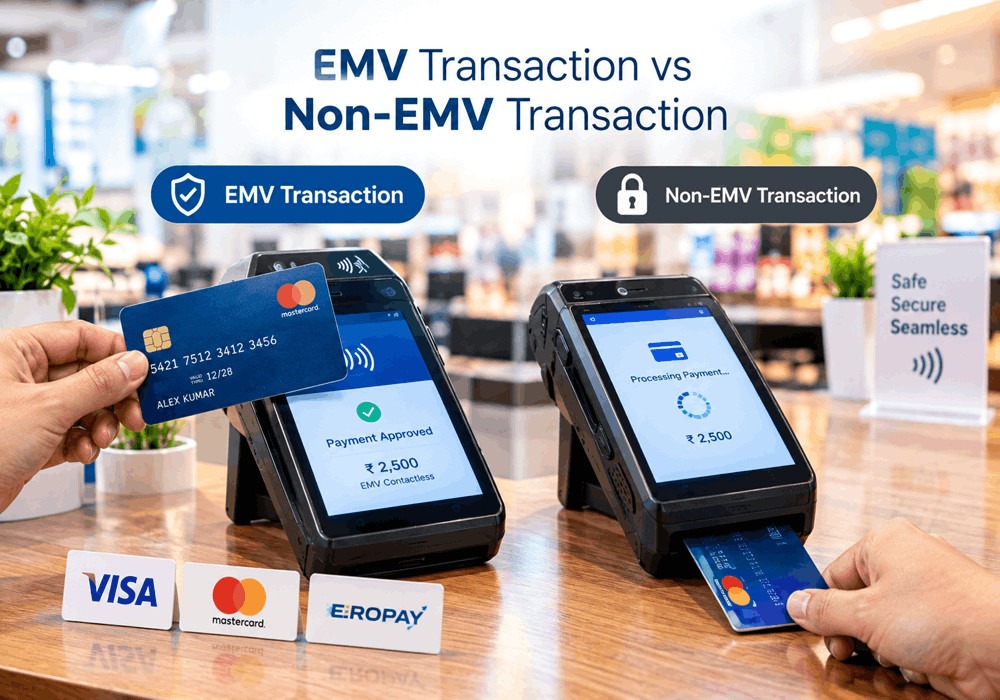
Every card payment settles one of two ways: through a secure, chip-driven EMV transaction, or through an older, less-protected non-EMV transaction. The difference sounds technical, but it decides who eats the loss when a card gets cloned, whether a terminal can legally process a sale in some markets, and how fast a business can start […]
EMV Certification Bottlenecks

In the rapidly evolving global payments landscape, where digital transactions are becoming the backbone of commerce and financial inclusion, the importance of achieving robust, secure, and compliant payment infrastructure has never been more critical. At the heart of this infrastructure lies EMV Certification, a globally recognized framework that ensures payment devices, applications, and transaction flows […]
How EMV Certification Works in the U.S.

In today’s highly interconnected and security-driven digital payments ecosystem, EMV Certification is not simply a compliance checkbox but a deeply technical, multi-layered validation process that determines whether a payment device, application or SoftPOS solution can securely and reliably process transactions across global payment networks. However, when businesses attempt to enter the U.S. payments market, they encounter a uniquely complex environment where certification is […]
TAC Denial in EMV Terminal Action Codes

In today’s fast-evolving payment ecosystem, security and risk management form the foundation of every digital transaction. Each time a chip-based EMV card interacts with a payment terminal, a series of complex verifications, cryptographic checks, and decision-making processes occur silently within milliseconds. These processes are not random they are governed by structured parameters defined by global […]
TAC Online in EMV Payments

In every payment transaction, there’s a critical moment when the terminal must decide:Can this transaction be approved offline, or should it reach out to the issuing bank for authorization? This decision lies at the heart of EMV risk management a balance between security, speed, and network efficiency. The process is governed by one of the […]
TAC Default in EMV
In digital payments, reliability is as vital as security. Merchants, acquirers and consumers expect that a transaction once initiated should either be securely approved or gracefully declined without disruption. But what happens when communication with the issuer fails? What if the network goes down or an authorization request doesn’t return in time? That’s where TAC–Default […]
Encryption Protocol Verification in L3 Certification

Encryption protocol verification within the EMV Level 3 Certification framework stands as one of the most technologically complex and strategically important validation processes in the entire EMV certification lifecycle, primarily because it determines whether a payment terminal, mobile-based SoftPOS application, QR–Payment Soundbox device, or multi-interface payment reader is capable of securely handling, encrypting, transmitting, and […]
Secure Cryptogram Generation and Validation in L3 Certification
Secure cryptogram generation and validation represent the absolute foundation of EMV transaction security, because cryptograms serve as cryptographically protected, issuer-verifiable artifacts that prove the authenticity of the card, the correctness of transaction data, the legitimacy of terminal risk management processes, and the integrity of the full EMV transaction path from the moment the card is […]
SDA vs DDA vs CDA in EMV Certification
Understanding the Importance of Offline Data Authentication in EMV Payment Systems In the continuously evolving landscape of payment technologies, where the global financial ecosystem increasingly relies on secure, reliable, and interoperable card-present transaction systems, EMV, which stands for Europay, Mastercard, and Visa, has emerged as the globally recognized standard for chip-based card authentication, encompassing a […]
Issuer Script Processing in EMV L3 Certification

Issuer Script Processing plays a pivotal role in ensuring the dynamic and secure management of payment cards,