
The rapid evolution of contactless payments in India and other emerging markets has driven a surge in demand for instant transaction feedback systems. Among the most disruptive innovations in this space is the Payment Soundbox, often referred to as the UPI Soundbox. This compact yet powerful device serves as an audible confirmation system that instantly announces the amount received when a digital transaction is completed via QR code. Its growing popularity is fueled by the seamless user experience it offers to merchants, the real-time transaction feedback it provides, and the increased consumer trust it fosters at point-of-sale locations.
A Payment Soundbox is more than just a speaker with a QR code on the front. Underneath its shell lies a multi-layered technical architecture that combines embedded hardware, firmware, communication protocols, and cloud infrastructure. It’s designed to deliver low-latency audio feedback while being cost-effective, secure, remotely manageable, and durable for harsh merchant environments. This article offers a comprehensive and highly detailed view of the Payment Soundbox architecture, explaining every layer and functional module involved in making these devices operate reliably at scale.
Core Components of a Payment Soundbox
The architecture of a Payment Soundbox can be broadly categorized into five critical layers, each playing an integral role in device performance, transaction handling, and cloud communication
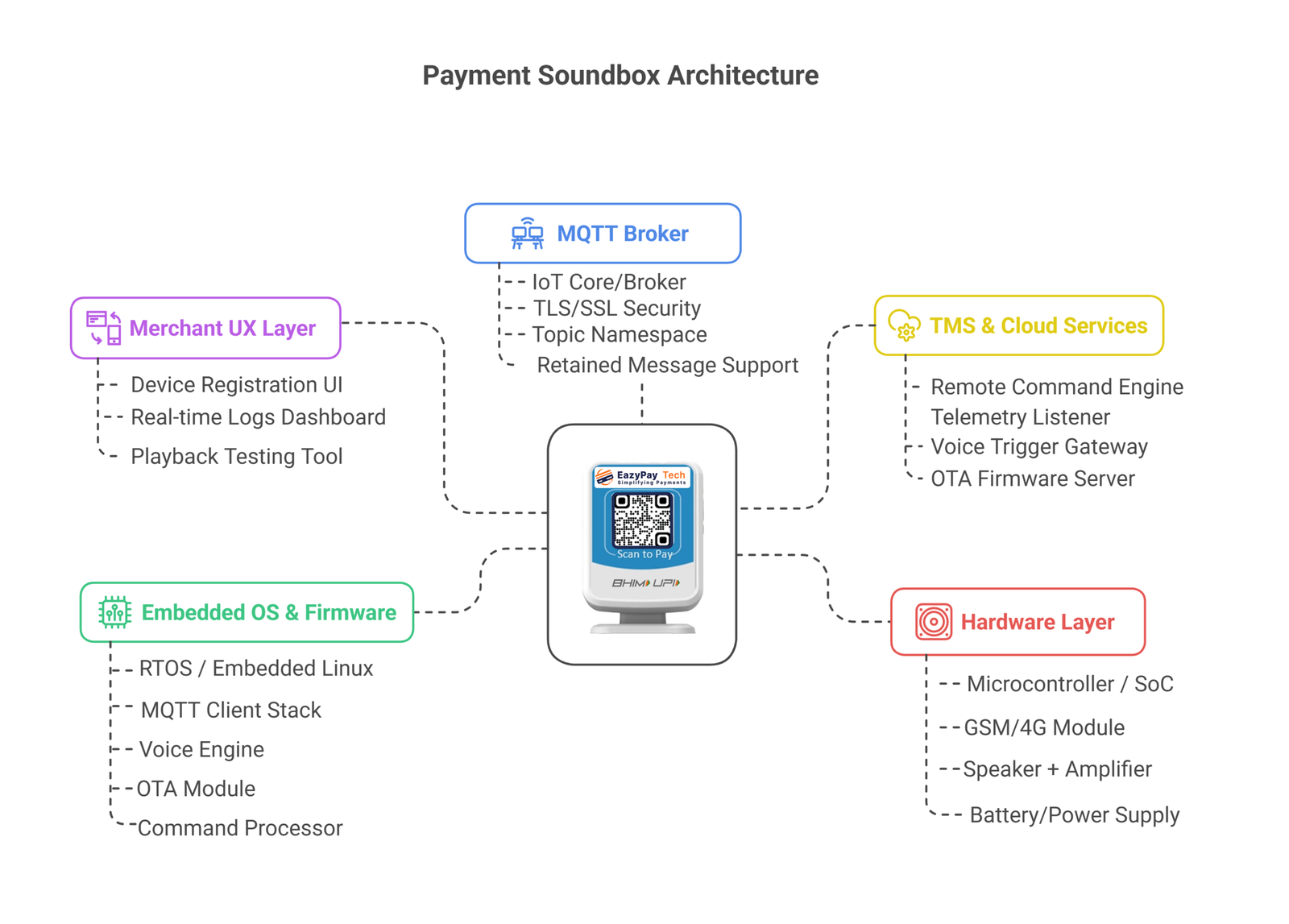
1. Hardware Layer
The hardware layer forms the physical foundation of the Payment Soundbox. It includes all the essential electronic components, power systems, and communication modules that interact directly with embedded software to carry out device-level functions.
- At the heart of this layer lies a microcontroller or System on Chip (SoC), typically based on ARM Cortex-M or A-series architecture, depending on performance requirements and cost constraints. This microcontroller acts as the command center, orchestrating all functions including communication, playback, and power management.
- Communication is enabled via an onboard GSM/4G, wifi module, allowing the Payment Soundbox to maintain persistent connectivity to the cloud through an Access Point Name (APN). This module facilitates MQTT communication and ensures real-time data transfer.
- For audio output, the device integrates a speaker and amplifier circuit. The amplifier ensures that audio playback remains loud and clear even in noisy retail environments. This speaker system delivers voice alerts such as “Payment received: ₹50 via UPI.”
- Power is supplied through a rechargeable lithium-ion battery, typically backed by a Power Management Integrated Circuit (PMIC) that handles charging, voltage regulation, and battery level sensing. Some models offer plug-and-play AC support, while others are designed to be portable and rely entirely on battery.
- All components are mounted on a custom-designed Printed Circuit Board (PCB), which may also include connectors for debugging, antennas, SIM cards, and test points for manufacturing diagnostics.
2. Embedded Operating System and Firmware
The embedded OS and firmware act as the brain of the Payment Soundbox, interpreting cloud commands, processing payment triggers, handling audio playback and maintaining secure communication. This layer is typically implemented using a Real-Time Operating System (RTOS) or lightweight embedded Linux distribution depending on the SoC used.
- The firmware includes a complete MQTT client stack that enables the device to subscribe to various topics such as /soundbox/device_id/play, /status and /ota for firmware updates. The MQTT protocol is chosen for its low bandwidth consumption, lightweight design, and efficient pub-sub mechanism ideal for IoT environments.
- A voice engine module within the firmware selects pre-recorded audio clips or text-to-speech (TTS) files depending on the nature of the transaction. For high-quality playback, it manages buffer queues and ensures messages are played in order of priority.
- OTA (Over-The-Air) update modules are also embedded, allowing the device to receive firmware updates without requiring any manual intervention. This ensures feature rollouts, security patches, and bug fixes can be deployed remotely.
- The command processing unit of the firmware parses incoming MQTT messages such as “volume up,” “reboot,” or “speak amount” and executes the corresponding functions accordingly. These messages may be encrypted and signed to ensure authenticity.
- A health monitoring module runs periodic diagnostics and reports battery levels, signal strength, firmware version, and errors back to the cloud via MQTT topics like /status, /battery, and /errors.
3. MQTT Broker (Cloud Layer)
At the heart of the cloud architecture lies the MQTT broker, a lightweight and highly scalable publish-subscribe message server. It acts as the central communication hub for all soundboxes deployed in the field, facilitating message exchange between devices, merchant dashboards, cloud APIs, and OTA services.
- The MQTT broker supports TLS/SSL encryption to secure all traffic between devices and the cloud, ensuring sensitive financial data is not intercepted during transit.
- It manages topic namespaces with a hierarchical structure such as /soundbox/{device_id}/play, /status, /logs, etc., helping isolate communication across thousands of devices while simplifying routing and scalability.
- Retained message support ensures that any last known message (e.g., firmware version or current volume level) remains available for new clients connecting to the topic.
- AWS IoT Core can be used depending on scalability, vendor lock-in, and SLA requirements. High availability clusters, replication, and load balancing are also typically configured to support millions of concurrent connections.
4. TMS and Cloud Services
The Terminal Management System (TMS) and associated cloud APIs handle the business logic, remote device control, and system-wide orchestration required to scale Payment Soundbox deployments.
- A Remote Command Engine acts as the orchestrator for administrative functions. It sends MQTT commands to reboot devices, adjust volume, initiate firmware updates, or trigger test playback.
- A Telemetry Listener subscribes to device-generated MQTT topics such as /status, /battery, /signal, and logs the data into a database for analysis, diagnostics, and dashboard visualizations.
- The Voice Trigger Gateway acts as an integration bridge between payment sources like UPI aggregators, QR systems, and the MQTT broker. When a payment webhook is received from PSP, it publishes a voice command to /sb/{device_id}/notify with the amount and transaction mode.
- The OTA Firmware Server hosts signed binaries and publishes update commands to the MQTT broker. The embedded device then downloads and installs the update over the air.
5. Merchant UX Layer
Merchant UX layer is critical for customer experience and support operations. It provides frontend access to cloud services, allowing administrators and support teams to interact with soundboxes in real-time.
- A device registration interface enables quick onboarding of new soundboxes by binding their unique IDs (e.g., MAC address or serial number) to merchant accounts.
- A real-time log dashboard visualizes device health metrics like last online status, battery levels, signal strength, and firmware versions. It supports filters for large-scale operations.
- A playback testing panel allows customer support or QA engineers to trigger test messages and verify audio functionality remotely. This tool is critical during installation and maintenance.
Payment Workflow of a UPI Soundbox
To understand the real-time responsiveness of a UPI Soundbox, it’s important to look at the end-to-end transaction flow that occurs when a customer completes a UPI payment using a QR code.
- The customer scans the QR code printed on the Soundbox or displayed on a separate terminal using any UPI-compatible app.
- The UPI aggregator receives the payment and triggers a webhook to the merchant’s backend or a centralized cloud gateway maintained by the Soundbox provider.
- The Voice Trigger Gateway listens to this webhook, validates it, and publishes a message to the MQTT broker with the topic /soundbox/1234/play and payload Payment received ₹250 .
- The Soundbox subscribed to the topic receives the message instantly and queues it for playback. The voice engine processes the message and plays the appropriate audio file.
- Simultaneously, the device publishes status updates like playback_success or battery_low to topics like /status or /alerts for monitoring.
This entire sequence is designed to complete within 2–4 seconds, ensuring minimal delay and real-time transaction feedback for both merchant and customer.
Key Advantages of Payment Soundbox Architecture
- Real-Time Payment Confirmation: The soundbox reduces customer disputes by confirming transactions audibly, thereby providing assurance to both the merchant and the customer.
- Offline Operation Support: Even in areas with low network coverage, queued MQTT messages and device buffers ensure continuity.
- Scalability: The MQTT-based architecture allows for scaling to millions of devices, as each device is isolated in its own namespace and independently managed.
- Remote Management: Thanks to TMS and OTA updates, firmware patches, diagnostics, and configuration changes can be rolled out without recalling devices.
- Cost Efficiency: Compared to mobile phones or tablets, a Payment Soundbox is significantly cheaper, power-efficient, and optimized solely for audio announcements.
Future Enhancements in UPI Soundbox Technology
- Voice Personalization: AI-generated regional voices for multilingual announcements are becoming more common.
- Bluetooth Pairing with POS: Some devices are being enhanced to sync with POS terminals over Bluetooth for consolidated billing and voice alerts.
- Rugged Outdoor Models: Waterproof, solar-powered models are under development for street vendors and outdoor merchants.
- Facial Recognition and Biometrics: Soundboxes integrated with face authentication for Aadhaar-linked UPI payments are being explored.
The Payment Soundbox, also popularly known as the UPI Soundbox, represents a perfect convergence of embedded systems, cloud infrastructure, and payment APIs. It is a fine example of how modular architecture—spanning hardware, firmware, and MQTT cloud messaging—can transform the everyday payment experience in one of the fastest-growing digital economies. As adoption continues to rise, future iterations of the Payment Soundbox will further leverage AI, multi-language capabilities, and advanced analytics to offer a more intelligent and inclusive payment environment for merchants of all scales.
The Payment Soundbox, is more than a simple audible alert device it’s an essential component in the evolving digital payments ecosystem, empowering merchants with real-time transaction confirmations and streamlining customer interactions. As adoption surges across sectors ranging from small retail shops to last-mile delivery agents, the demand for reliable, scalable, and feature-rich soundbox architectures continues to grow. At EazyPay Tech, we specialize in developing custom Payment Soundbox solutions tailored to the unique needs of payment service providers, banks, fintechs, and OEMs. Our expertise spans the entire technology stack—from embedded hardware design and MQTT-based firmware to secure cloud orchestration and merchant UX dashboards—ensuring end-to-end functionality, rapid deployment, and compliance with evolving UPI and regulatory standards. Whether you’re launching a new UPI initiative or scaling an existing one, our configurable Soundbox platforms offer the flexibility, performance, and support required to stay ahead in the fast-moving world of contactless payments.