
The meteoric rise of UPI (Unified Payments Interface) has ushered in a new era of contactless payments, with QR code-enabled soundboxes becoming integral tools for real-time transaction confirmation. These compact, voice-enabled devices are not just useful they’re redefining merchant-customer trust, especially across small merchants, kirana stores, and MSMEs.
But managing the lifecycle of thousands or even millions of these devices, deployed in different regions, operated by users with different digital fluency levels, requires a scalable, smart, and secure infrastructure. That’s where a Terminal Management System (TMS) becomes the architectural foundation of success.
What is a Terminal Management System (TMS) payment Sound Box ?
A Terminal Management System (TMS) is an enterprise-grade backend platform that enables secure, remote management of field-deployed payment terminals particularly QR Payment soundboxes and UPI sound devices.
Acting as the digital command center for thousands of devices, TMS supports:
- Remote provisioning & onboarding
- Firmware and QR code updates
- Real-time diagnostics
- Fraud control
- Geofencing and location tracking
- Language/audio personalization
Whether you’re deploying soundboxes in rural retail shops or tier-1 urban supermarkets, TMS ensures your devices are always online, updated, and functioning optimally.
Core Architectural TMS for QR Payment Soundbox Ecosystem
A robust and scalable Terminal Management System (TMS) designed for managing QR payment soundboxes consists of multiple interdependent architectural layers, each tailored to enable seamless payment processing, real-time communication, device control, security compliance, and analytics.
1. Device Layer (Edge Layer)
This is the foundational layer that comprises the physical QR Soundbox hardware and embedded software stack. It ensures edge-level intelligence, local audio playback, and secure communications.
- Embedded Firmware Functionality: The device is embedded with custom firmware that enables real-time operation, manages peripherals like the speaker, controls audio playback, and communicates with the TMS platform.
- Payment Detection & Transaction Feedback: Payment events are detected indirectly through backend webhook notifications from UPI PSPs (like BHIM, PhonePe, Paytm). The firmware listens for audio playback commands triggered from these transaction events.
- Voice Output Engine: The device includes a local audio playback module that plays preloaded or OTA-pushed audio files like “₹XXX received via UPI” using a high-quality speaker to ensure clarity in noisy retail environments.
- Connectivity via SIM or Wi-Fi: Devices are equipped with either 2G/4G LTE modules for mobile connectivity or Wi-Fi modules for broadband-based internet. These ensure always-on, low-latency communication with the central server.
- Security Infrastructure on Device:
- Secure Boot: Ensures only signed and validated firmware is loaded during startup.
- Key Storage: Cryptographic keys are securely stored using a secure element (SE) or trusted execution environment (TEE).
- Firmware Signature Validation: Every firmware update is digitally signed and verified before installation, preventing tampering or injection attacks.
2. Communication Layer
This layer guarantees real-time, encrypted, and persistent communication between devices and backend servers.
- MQTT Protocol Support: Lightweight, persistent publish-subscribe communication protocol used for real-time push messages like audio triggers, heartbeats, alerts, or commands.
- RESTful APIs over HTTP/HTTPS: Supports synchronous communication like onboarding, configuration updates, and reporting, typically used by external systems or during device registration.
- TLS Encryption & Mutual Authentication:
- Ensures data confidentiality and device-server identity verification.
- Device certificates (X.509) are often used to authenticate connections to the MQTT broker.
3. Device Gateway / API Gateway
This layer acts as the traffic controller for large-scale device communications and system integrations.
- Load Balancing & Scaling: High-availability load balancers distribute device connections across multiple MQTT brokers or API endpoints to maintain performance under high concurrent loads.
- Protocol Routing & Conversion: Handles various communication protocols such as MQTT, HTTPS, and CoAP, translating device messages to internal microservice-compatible formats.
- Device Identity Management:
- Tracks IMEI (modem), ICCID (SIM), MAC Address (Wi-Fi), and Device IDs.
- Supports lifecycle operations like registration, blacklisting, and locking based on identity flags.
4. Core TMS Engine (Application Layer)
This is the functional and operational brain of the system, handling device state, commands, alerts, and configurations.
- Job Scheduler: Periodically executes queued jobs such as firmware rollouts, audio pack updates, or device status scans, with support for prioritization and retries.
- Alert & Notification Engine: Automatically detects and raises alerts for critical events such as battery low, device offline, speaker failure, or firmware mismatch.
- Command Dispatcher: Orchestrates remote commands like:
- Lock/unlock device
- Push audio files or voice templates
- Trigger soft reboots or diagnostics
- Rules Engine: Applies real-time logic such as:
- Blocking audio playback for geofence breaches
- Detecting usage outside merchant operational hours
- Preventing duplicate audio triggers on repeated webhooks
- Transaction Correlation Module: Optionally syncs UPI transactions with payment service providers for reconciliation, duplicate filtering, or audit logging.
5. Database Layer
This layer stores structured, semi-structured, and time-series data generated by the TMS ecosystem.
- Relational Database (e.g., PostgreSQL, MySQL):
Stores structured metadata like device registration details, merchant profiles, configuration parameters, and command history. - Time-Series Database (e.g., InfluxDB, TimescaleDB):
Optimized for high-frequency metrics like heartbeat status, signal strength, battery voltage, temperature, and device location over time. - NoSQL Databases (e.g., MongoDB):
Ideal for storing unstructured or semi-structured data like audio templates, logs, firmware metadata, alert snapshots, and device configuration blobs.
6. Dashboard / Admin UI Layer
A web-based or mobile-accessible admin interface used by internal operators, merchants, and support teams.
- Role-Based Access Control (RBAC):
Different permissions for admins, field agents, merchants, and support teams with strict audit logging. - Real-Time Monitoring Dashboard:
Shows device health, last-seen timestamp, location, firmware version, battery percentage, and signal strength. - Command Console:
Enables operators to send push commands (e.g., reboot, lock), publish firmware, or trigger diagnostics. - Analytics & Visualization:
Provides charts for transaction volume, uptime, audio success rate, payment success rate, and geospatial maps of device activity.
7. Integration Layer
Interfaces that allow TMS to work with external fintech, banking, CRM, and logistics systems.
- Webhook Handling for UPI PSPs:
Secure API endpoints that accept real-time payment confirmations from providers like BHIM, PhonePe, Paytm, etc. - CRM Integration:
Syncs merchant KYC, onboarding status, support tickets, and QR code assignment with enterprise systems. - Logistics / Warehouse API Hooks:
Updates inventory, activation status, and shipment status during the device provisioning lifecycle. - SDK & API for Partners:
Fintechs can build custom dashboards, reporting tools, or integrate device control features via exposed REST or gRPC APIs.
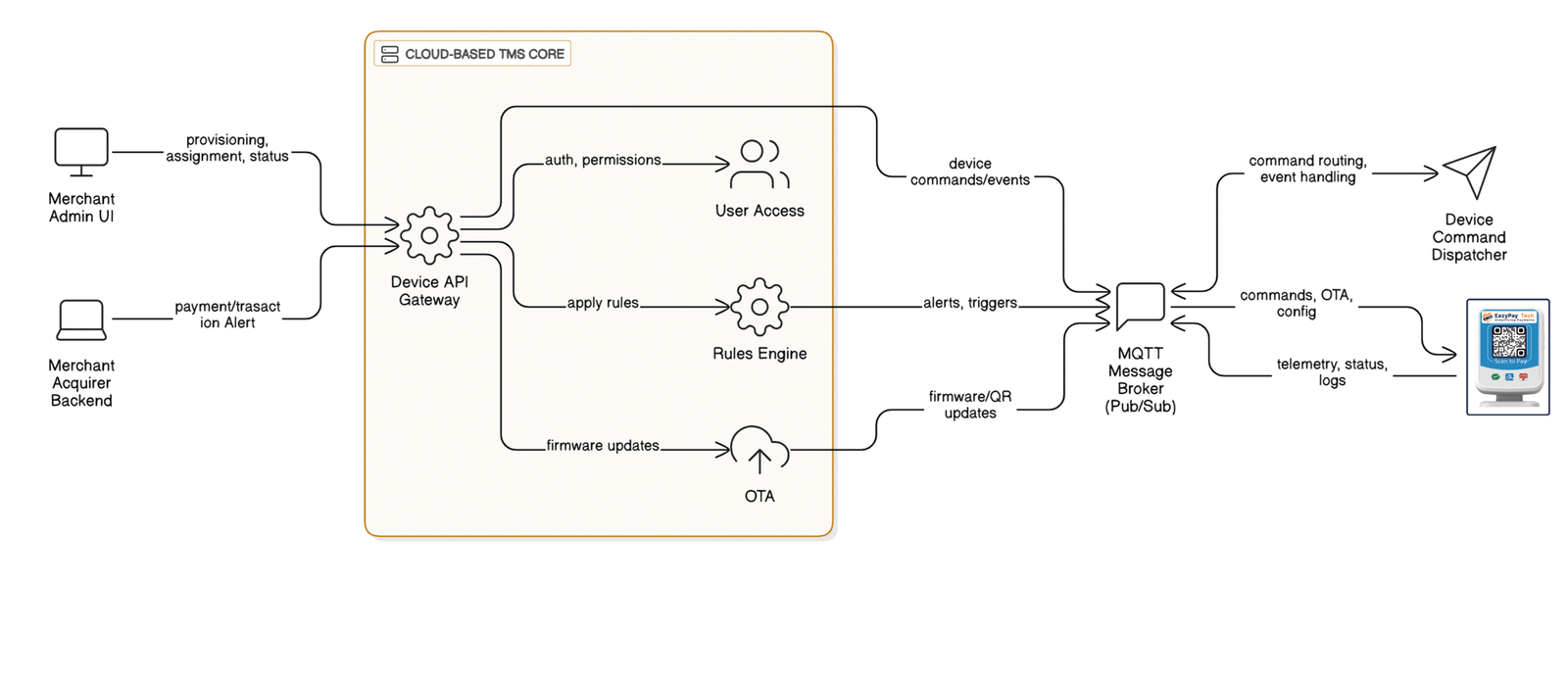
Detailed Architectural Workflows
A. Device Onboarding Workflow
- Device Manufacturing & Provisioning: QR soundbox is assembled, embedded with secure firmware, and loaded with a signed root certificate for authentication.
- SIM Installation & Registration: Unique Device ID is generated and mapped with its SIM ICCID, IMEI, MAC address, and optionally geotag.
- Merchant Onboarding: Merchants are onboarded via a dedicated mobile app, CRM system, or partner portal where KYC and business details are captured.
- Metadata Exchange: Device connects to the TMS and securely transmits metadata (IMEI, ICCID, firmware version, geolocation).
- QR Code Assignment: Based on merchant mapping, either a static or dynamic UPI QR code is pushed to the device for display or printing.
- Activation & Monitoring: Device is marked as “Online” and begins sending periodic heartbeats to indicate readiness.
B. UPI Payment and Voice Trigger Workflow
- Customer Initiates Payment: End-user scans the UPI QR code on the soundbox and completes a transaction using their UPI app.
- Webhook Received by TMS: The PSP (e.g., BHIM or PhonePe) sends a webhook containing transaction details such as UPI ID, amount, Txn ID, and merchant ID.
- Transaction Mapping: TMS validates the webhook payload, associates it with the correct device, and formats a voice announcement template.
- Voice Command Push: Using MQTT, the TMS sends an encrypted command to the soundbox instructing it to play the transaction voice alert (e.g., “₹150 received via UPI”).
- Audio Playback: The soundbox decodes the audio packet and plays the voice alert through its speaker.
- Logging & Acknowledgement: TMS records a success log, including timestamps, audio playback confirmation, and device metrics at the time of transaction.
C. OTA Firmware / Audio Update Workflow
- Update Rollout Initiated: TMS admin uploads new firmware/audio pack and creates an update schedule based on filters (device type, region, firmware version).
- Update Push via Scheduler: Devices receive a lightweight MQTT message indicating an update is available, with a secure download URL.
- Secure Download & Verification: Device downloads the binary or audio package and performs a CRC check and digital signature verification.
- Installation & Reboot: Upon verification, the device installs the update and optionally reboots for changes to take effect.
- Result Logging: Device sends an acknowledgment back to TMS, which logs success/failure status and retry schedules if needed.
D. Remote Lock / Geofence Enforcement
- Geolocation Monitoring: Devices periodically report GPS coordinates. TMS cross-verifies this against assigned merchant geofence.
- Violation Detected: If the device is used outside the authorized location, a geofence breach alert is triggered.
- Command Issued: TMS pushes a remote lock command, disabling audio playback and potentially hiding the QR code.
- Admin Review Required: Device remains in locked state until an operator or admin resolves the geofence violation manually.
Security Architecture & Compliance Measures
- End-to-End Encryption (E2EE): All MQTT and HTTPS payloads are encrypted using TLS 1.2/1.3 and device credentials.
- Secure Element (SE) on Device: Dedicated hardware module to store private keys and perform cryptographic operations securely.
- Digitally Signed Firmware: Each firmware package is signed using the provider’s private key and verified on-device using the corresponding public key.
- IMEI/ICCID Binding: Devices are locked to their SIM and modem identities to prevent cloning or spoofing.
- Certifications & Compliance:
- ISO 27001 for Information Security
- PCI DSS Level 1 for payment data handling
Scalability & High Availability Architecture
- Sharded Relational Databases: Distribute device records and transaction logs across multiple database shards for high throughput.
- Horizontally Scalable MQTT Clusters: Deploy EMQX or Mosquitto brokers with HA configurations across cloud zones.
- Containerization with Orchestration: Use Docker + Kubernetes for microservices, auto-scaling, and failure recovery.
- Message Queue Buffers: Use Kafka or RabbitMQ to decouple webhook ingestion from audio dispatch processing.
- CDN-backed OTA Distribution: Host firmware and audio packages on CDN for global reach and high-speed downloads.
Merchant Support and CRM Integration
- Real-Time Sync with CRM: Synchronize merchant status, profile, and device mappings bi-directionally for consistency.
- Support Workflow Integration: Auto-generate support tickets for offline devices, playback failures, or battery issues.
- Custom QR Assignments: Push merchant-specific static/dynamic QR codes based on CRM metadata.
- Reports & Dashboards: Generate merchant-wise performance reports, usage history, device health summaries, and support interactions.
TMS-Driven Analytics & AI Insights
- Heatmaps: Visualize areas with the highest transaction frequency across districts, cities, or store chains.
- Predictive Maintenance: Use telemetry patterns to forecast battery failures, speaker issues, or SIM outages.
- ML-Based Fraud Detection: Analyze anomalies like multiple webhooks for a single transaction, repeated device movement, or excessive resets.
- Merchant Behavior Modeling: Cluster merchants by transaction volume, time-of-day usage, or region-based performance for targeting offers.
- Geo-Demographic Analysis: Correlate payment behavior with regional income, mobile penetration, or store types.
Future of TMS in UPI Soundbox Ecosystem
TMS is evolving from a static backend into an AI-powered control center. Here’s what the future holds:
- AI for Fraud Detection: Analyze behavioral anomalies to identify fraud or device tampering.
- Dynamic QR Assignments: Allocate QR codes based on category, region, or merchant performance.
- CRM Integration: Seamlessly connect merchant transaction history with loyalty campaigns.
- Smart Audio Campaigns: Push audio ads, festive greetings, or bank promotions based on time and region.
Top 10 Features of a Modern TMS for QR Soundbox Management
1. OTA Firmware and Software Updates
Update all your devices remotely whether it’s a security patch, new audio voice prompts, or app features.
2. Remote QR Code & Merchant Handle Reconfiguration
Change UPI QR codes linked to new merchant accounts without physical intervention.
3. Health Monitoring Dashboard
Track real-time metrics like:
- Battery level (for rechargeable units)
- Speaker audio quality
- Device temperature
- Firmware version
- Last ping timestamp
4. SIM Card & Connectivity Monitoring
Get alerts on:
- SIM failure or ejection
- Low signal strength
- Excessive data consumption
- Preferred network auto-switching
5. Geolocation & Geofencing
Track exact GPS coordinates and receive alerts when a soundbox crosses predefined geo-boundaries.
6. Remote Lock & Unlock Capability
If a device is stolen, lost, or misused, lock it instantly from the dashboard.
7. Audio Language & Brand Personalization
Change voice alerts to regional languages or branded greetings. Push personalized audio campaigns.
8. Event-Based Alerting System
Receive real-time alerts for:
- Device offline > X hours
- Battery low or charging failure
- Audio prompt failure
- Abnormal transaction volumes
9. Usage & Transaction Analytics
Track:
- Number of transactions per device
- Peak usage hours
- Geo-based usage heatmaps
10. Lifecycle Management
From warehouse to merchant to retirement, every stage of a QR soundbox’s life is logged and controlled.
TMS is the Central Brain of QR Soundbox Deployments
The QR soundbox may be the merchant’s best friend, but it is the TMS architecture that acts as its remote caretaker, troubleshooter, and brain. Without an advanced, layered TMS, scaling QR-based UPI sound payment systems would be nearly impossible in markets like India.
By building the right architectural foundation—cloud-first, real-time, AI-capable, and security-tight—fintech providers and device manufacturers can unlock the full potential of QR soundbox networks.
Ready to build or upgrade your TMS stack? Partner with EazyPay Tech to deploy, scale, and manage your soundbox fleets like a pro.